Much has been said about the high environmental cost of cement, so one might assume that a ceramic bowl has a lower impact than a cement bowl, especially given the widely held belief that ceramics are renewable, when in reality they aren’t. What follows is an exploration of these two materials, their energy needs, and a little dive into the naturalness of things.
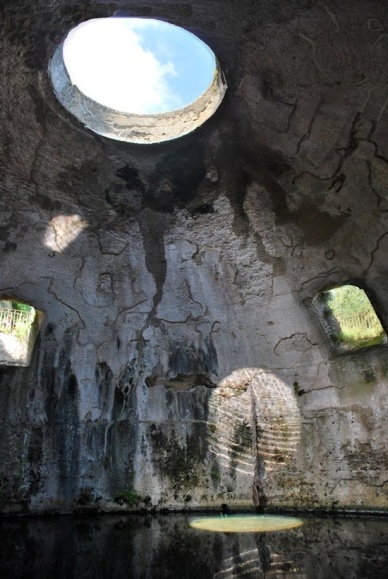
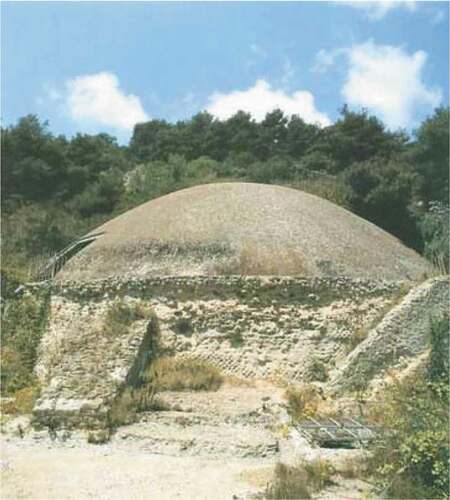
Cement Oculus at Baiae - Attribution Unknown
Before writing this, I wasn’t sure if the bias I noticed against cement was real, a random thought sublimated into my mind in a world where every action might be scrutinized in terms of CO2 output. There was honestly a bit of guilt floating around within me as I cast objects in cement. What I found in an ‘ai’ search result revealed the bias to be real, more than just a subtle notion sopped up from the plate of zeitgeist.
The first three-dimensional objects I ever created were made from clay, maybe playdough if I could remember. Years later, I became more interested in cement; it was a more accessible material, mostly because I didn’t need a kiln to create a stone-like object.
Though both clay and cement have been used for thousands of years, I noticed a stark difference in the way people talk about these materials. For example, ceramics is commonly thought of as natural, as opposed to concrete.
I began to wonder (again, as I have many times pondered the word ‘natural’), how it is that some things made by humans become natural in the mind, and others unnatural, often seen in terms of good and evil.
Cement-ish: Coccolithus Pelagicus by Richard Lampitt et al.
Collecting in the banks of streams and rivers is the clay used for your ceramic mug, composed of the smallest of rock particles resulting from weathering. Cement largely comes from a biological sediment that filters down to the bottom of the ocean, where it collects in thick layers, one day rising above the surface as stone, collected and used for making cement. For both materials, heat is an essential element in the process to turn wet dust into an object.
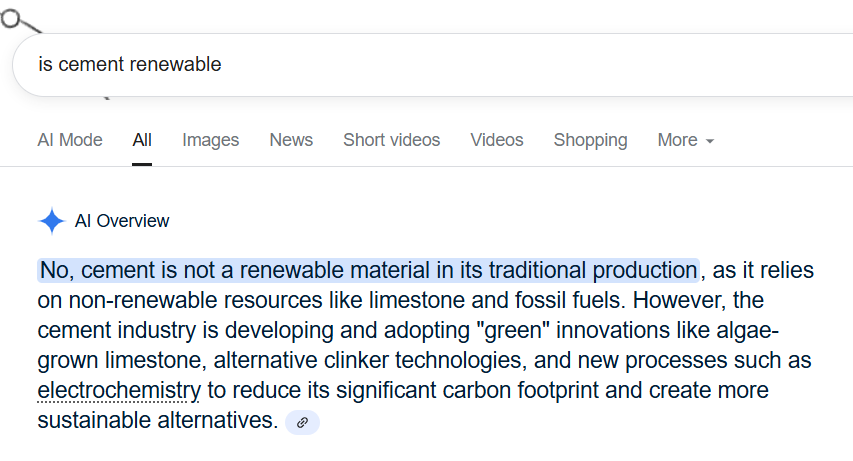
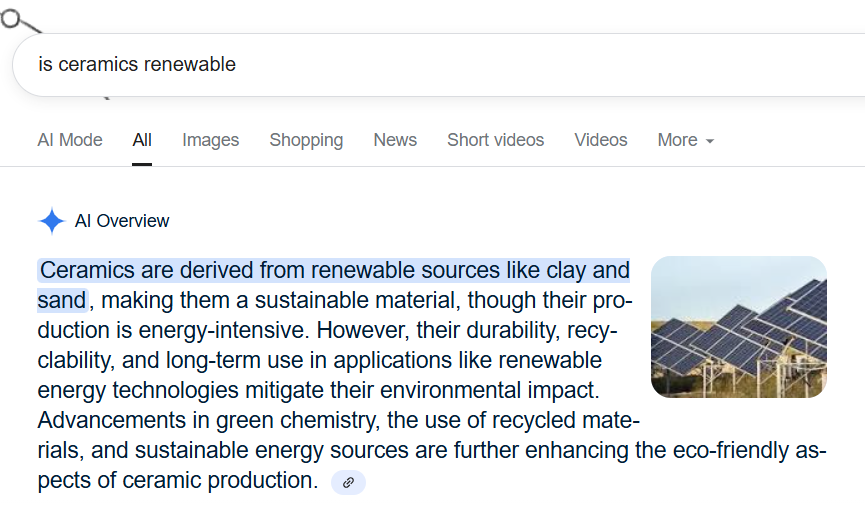
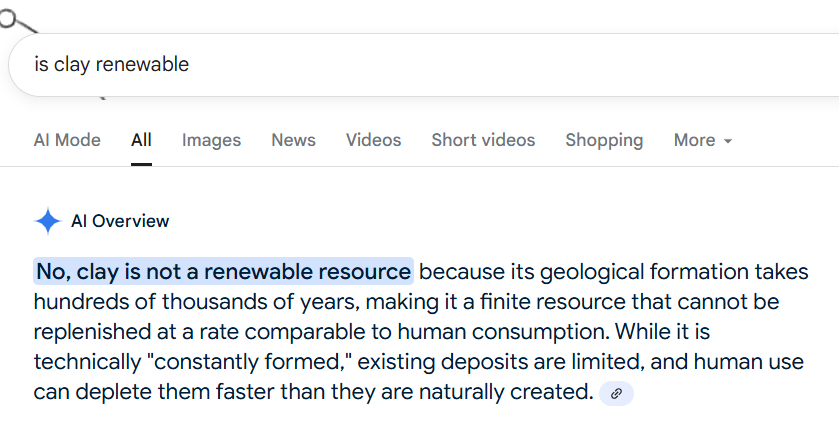
Here are the search results of the ‘ai’ regurgitate.
When asked – Is cement renewable? The answer is NO, this is true on a human timescale.
Then when asked – Is ceramics renewable? The answer was YES, the real answer is NO.
When you ask if clay is sustainable, then the answer is no, stating that it takes hundreds of thousands of years to accumulate the clay deposits needed for harvesting.
This is a quote from a study that gives a little glimpse into our use of clay.
Over 400,000,000 tons of kaolin has been produced from the deposits in Georgia in the USA. Within the next few years the kaolin production in Georgia will be downsized because of the depletion of reserves. The same is true in England but fortunately there are several hundred million tons of high quality kaolin reserves in Brazil, which will become the world production leader in this century. (Industrial Clays Case Study, Haydn Murray)
Was this ‘ai’ mistake related to human words gobbled up by ‘crawler bots’ scouring the internet? It seems likely the words were reassembled in the same way they were consumed.
Google might know the source of this error, but would they tell me? Instead, I’m going to guess. I think there is a common assumption that living in the country and making ceramic mugs is ‘sustainable’, while urban life, concrete life, is not. The truth is closer to the opposite. A sustainable world is a place where resources are shared by as many people as possible, such as roads, transportation, tools, books, etc. It is a world where repairing things becomes normal again, an integral part of the initial design. The opposite of the current doctrine of planned obsolescence.
Energy cost of cement compared to ceramics
Though small-scale ceramics producers can fire their wares using an electric kiln, the grid energy might be from coal or ‘natural’ gas. I knew from personal experience that even small-scale studios use natural gas, especially for the glaze firing, which requires high temperatures. These kilns have a little peephole with a plug so you can gauge the temperature, just be careful not to burn your eyeball.
Pyrometric cones: Segerkegel CC
At an industrial scale, the energy used comes almost exclusively from natural gas, currently in the year 2025. It is not that electric tunnel or rotary kilns do not exist, but they aren’t commonly used across global industry.
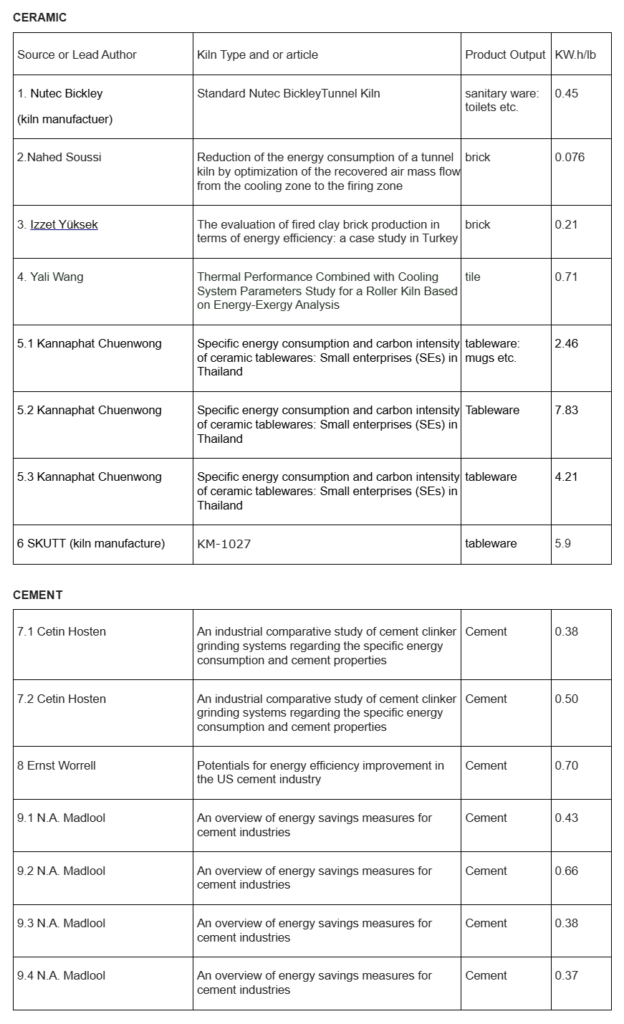
Before I wrote this, I couldn’t find casual writings comparing the energy needs of these two materials, so I looked to academic journals where I knew I could find some numbers. The units were all over the place, but after conversion, I found what I was seeking. Not a clear answer, but more light. It seemed to me that if I were to make the same object in cement or clay, pound for pound, the cement object would have a lower energy cost. Though this makes me feel a little better about using cement, I still see a problem with the use of fossil fuels. As my table demonstrates, large-scale production kilns are much more efficient than home kilns, so any dream of producing my own cement would only arise out of the esoteric dungeon of artisanal madness.
For purposes of simplicity, the units from each source were converted to the same type. Pay attention to the last four rows of ceramic data. This represents the best analogue to understand the energy-efficiency of medium to small-scale ceramic producers, my comrades of production, so to speak. When you look at large-scale kilns, you can see that the efficiency is much greater than that of smaller kilns.
I did not write this to put ceramics in its place within a hierarchy of ‘greenness’, but rather to illuminate something clouded by bias.
The problem with cement or ceramics on an individual level is tiny; the real issue is on the industrial scale. It is a global problem we face, and it falls particularly on the nations that have the resources to make better kilns, to use them, and to share these technologies with developing countries. It is the scale that cement is used by industry that makes its carbon output relevant within the scope of climate change. And though ceramics is no small industry, its comparatively smaller size has minimized its relevance.
Ideas have little meaning in isolation; everything on this planet is in relation. The same ‘fact’ can easily change in meaning when zooming in or out; somewhere in the middle is a familiar story.
Given new information, would you change your mind?
The Cement Dome of the Temple of Diana in Baiae - Attribution Unknown